
Witr Prayer Guide: How to Pray Witr Salah Step by Step, Benefits, Timing, Dua Qunoot, and Complete Islamic Rulings
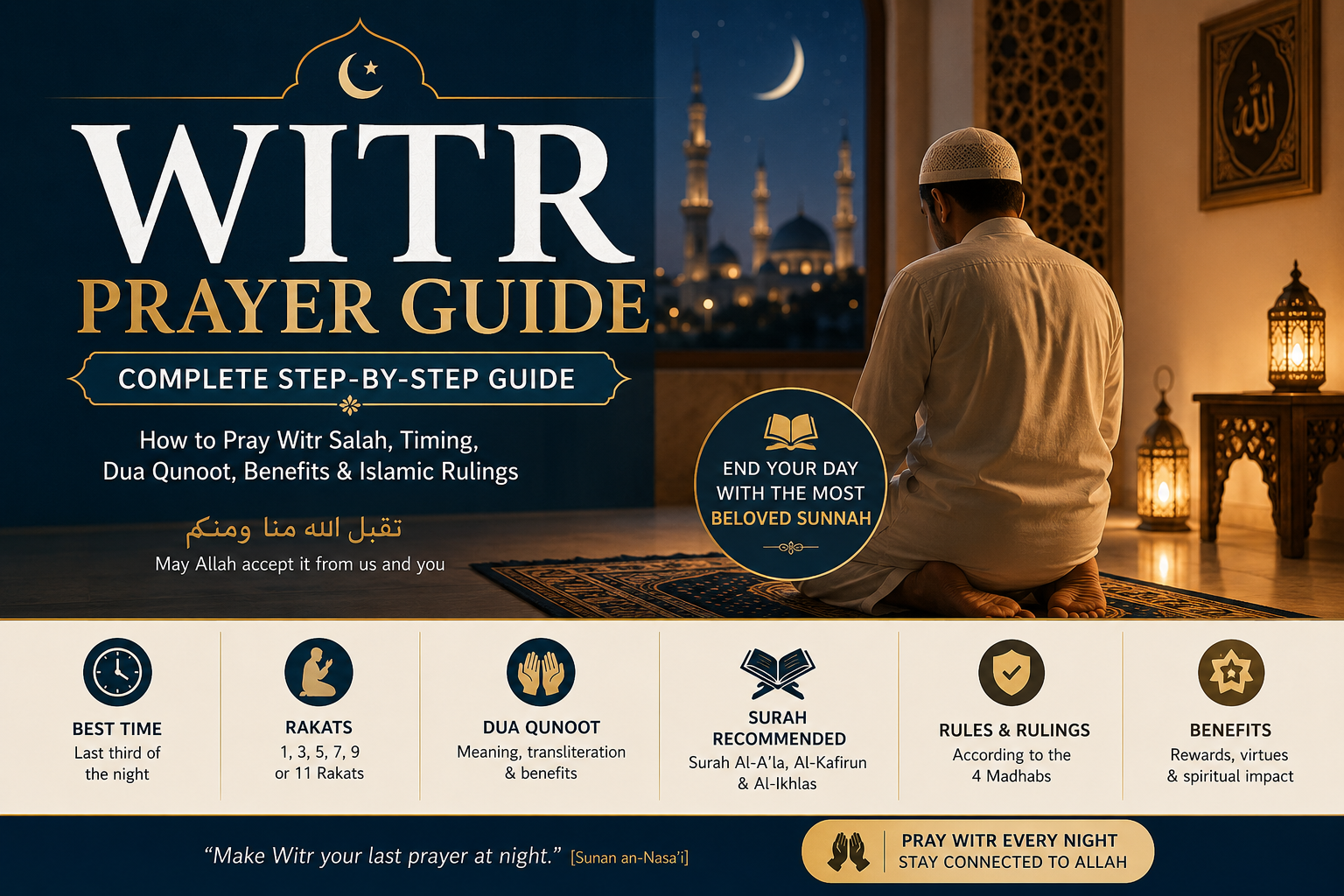
What Is Witr Prayer?
Witr Prayer is one of the most important nightly prayers in Islam. It is performed after Isha prayer and before Fajr prayer. The word “Witr” means odd or singular. This refers to the odd number of rakats offered during the prayer. Muslims around the world perform Witr as the final act of worship before sleeping or after completing Tahajjud prayer. The Prophet Muhammad ﷺ consistently observed Witr and strongly encouraged his followers to do the same. According to the Hanafi school of thought, Witr is Wajib. The Shafi’i, Maliki, and Hanbali schools classify it as a highly emphasized Sunnah known as Sunnah Muakkadah. Regardless of the scholarly classification, Islamic scholars agree that Witr is among the most important non-obligatory prayers a Muslim can perform.Quick Answer: What Is Witr Prayer?
Witr Prayer is an odd-numbered night prayer offered between Isha and Fajr. It can be prayed as 1, 3, 5, 7, 9, or 11 rakats. Most Muslims commonly perform three rakats and recite Dua Qunoot in the final rakat.Why Is Witr Prayer Important in Islam?
Witr occupies a unique position among Islamic acts of worship. Unlike many optional prayers that the Prophet ﷺ occasionally performed, he consistently maintained Witr throughout his life. The Messenger of Allah ﷺ said:“Allah is One and loves what is odd. Therefore pray Witr.”This hadith demonstrates the special significance of ending one’s day with an act of worship dedicated solely to Allah. Another narration states:
“Make Witr your last prayer at night.”This instruction highlights the role of Witr as the spiritual conclusion of a Muslim’s daily worship.
Spiritual Benefits of Witr Prayer
Witr provides several spiritual benefits:- Strengthens faith
- Increases remembrance of Allah
- Encourages sincere repentance
- Develops consistency in worship
- Creates a stronger connection with the Quran
- Helps believers end the day with gratitude
Witr Prayer in the Quran
Although the Quran does not explicitly command Witr prayer by name, numerous verses encourage night worship and remembrance of Allah.Surah Al-Isra (17:79)
“And during the night wake up for prayer as an additional worship for you.”Tafsir Explanation
Classical scholars such as Ibn Kathir and Al-Tabari explained that this verse encourages voluntary night prayers including Tahajjud and Witr. The verse highlights the virtue of standing before Allah during the quiet hours of the night.Surah Adh-Dhariyat (51:17-18)
“They used to sleep but little of the night. And before dawn they would seek forgiveness.”Tafsir Explanation
This verse describes the righteous servants of Allah who devoted part of their nights to worship and repentance. Witr prayer provides an ideal opportunity to fulfill this description by seeking forgiveness before sleeping or before dawn.Hadith About Witr Prayer
Numerous authentic hadith emphasize the importance of Witr.Hadith 1
The Prophet ﷺ said:“Witr is a duty upon every Muslim.”
Hadith 2
The Prophet ﷺ said:“Allah has granted you an additional prayer. It is Witr.”
Hadith 3
The Prophet ﷺ instructed:“Make the last of your prayers at night Witr.”
Hadith 4
The Prophet ﷺ regularly performed Witr whether traveling or residing at home.Hadith 5
The Messenger of Allah ﷺ sometimes prayed one rakat of Witr.Hadith 6
He also prayed three rakats of Witr.Hadith 7
On some occasions he prayed five rakats.Hadith 8
He sometimes prayed seven rakats.Hadith 9
There are authentic narrations describing nine rakats.Hadith 10
Some narrations report eleven rakats of Witr combined with night prayer. These authentic narrations demonstrate flexibility within Islamic worship while maintaining the core principle of odd-numbered prayer.What Time Does Witr Prayer Start?
Witr begins immediately after Isha prayer. A Muslim may perform Witr at any time during the night after completing Isha.Example
If Isha begins at 8:30 PM and Fajr begins at 4:15 AM, Witr may be prayed anytime within that period. This flexibility makes Witr accessible for people with different schedules.When Does Witr Prayer End?
The time for Witr ends when Fajr begins. Once the Fajr prayer time starts, the opportunity to perform Witr for that night has ended. Because of this, scholars recommend avoiding unnecessary delays.What Is the Best Time to Pray Witr?
The best time is during the final third of the night. This period holds exceptional spiritual significance. The Prophet ﷺ informed believers that Allah’s mercy descends during the last third of the night and invites people to seek forgiveness, make dua, and ask for their needs.If You Wake for Tahajjud
Pray Tahajjud first. Then conclude your worship with Witr.If You Do Not Wake for Tahajjud
Pray Witr before sleeping. This ensures that you do not miss the prayer.How Many Rakats Are in Witr Prayer?
Islam allows multiple authentic methods.| Method | Rakats |
|---|---|
| Minimum Witr | 1 |
| Common Witr | 3 |
| Extended Witr | 5 |
| Extended Witr | 7 |
| Extended Witr | 9 |
| Extended Witr | 11 |
Most Common Method
The three-rakat method remains the most widely practiced across the Muslim world. It is especially common among followers of the Hanafi school.How to Pray Witr Salah Step by Step
Step 1: Make Niyyah
Begin with a sincere intention in your heart. The intention should be to perform Witr solely for Allah. No verbal statement is required.Step 2: Pray the First Rakat
- Say Allahu Akbar
- Recite Surah Al-Fatihah
- Recite another Surah
- Perform Ruku
- Stand upright
- Perform two Sujood
Step 3: Pray the Second Rakat
Repeat the same structure. After the second Sujood, sit for Tashahhud.Step 4: Stand for the Third Rakat
Recite:- Surah Al-Fatihah
- Another Surah from the Quran
Step 5: Recite Dua Qunoot
Recite Dua Qunoot before proceeding to Ruku according to the Hanafi method.Step 6: Complete the Prayer
- Perform Ruku
- Perform two Sujood
- Sit for final Tashahhud
- Recite Salawat
- End with Salam
Dua Qunoot in Witr Prayer
Dua Qunoot is among the most recognizable elements of Witr.Arabic
اللهم إنا نستعينك ونستغفرك ونؤمن بك ونتوكل عليكTransliteration
Allahumma inna nasta’inuka wa nastaghfiruka wa nu’minu bika wa natawakkalu alaykaTranslation
O Allah. We seek Your help. We seek Your forgiveness. We believe in You and place our trust in You.Meaning and Reflection
Dua Qunoot combines several essential elements of Islamic faith:- Reliance upon Allah
- Seeking forgiveness
- Belief in Allah
- Gratitude
- Humility
Surahs Commonly Recited in Witr
The Prophet ﷺ frequently recited specific surahs during Witr.First Rakat
Surah Al-A’laSecond Rakat
Surah Al-KafirunThird Rakat
Surah Al-Ikhlas These chapters emphasize:- Tawhid
- Sincerity
- Devotion to Allah
- Rejection of shirk
Witr Prayer According to the Four Madhabs
Islamic scholars developed slightly different methods based upon authentic narrations.Hanafi School
Associated with Imam Abu Hanifa Characteristics:- Witr is Wajib
- Three rakats
- Dua Qunoot before Ruku
Shafi’i School
Associated with Imam Al-Shafi’i Characteristics:- Sunnah Muakkadah
- One or more odd rakats
- Qunoot often after Ruku
Maliki School
Associated with Imam Malik Characteristics:- Highly emphasized Sunnah
- Flexible structure
- Strong emphasis on following authentic practice
Hanbali School
Associated with Imam Ahmad ibn Hanbal Characteristics:- Several authentic methods accepted
- One-rakat Witr considered valid
- Emphasis on hadith evidence
Witr During Ramadan
Witr becomes even more significant during Ramadan. After Taraweeh prayers, many mosques conclude the congregation with Witr. This practice allows worshippers to complete their nightly prayers together. During the final ten nights, Muslims often combine:- Taraweeh
- Tahajjud
- Witr
- Extended dua
Witr and Tahajjud Prayer
One of the most common questions concerns the relationship between Witr and Tahajjud. The preferred sequence is:- Tahajjud
- Witr
Common Mistakes Muslims Make in Witr Prayer
Skipping Witr Frequently
Many Muslims underestimate its importance. The Prophet ﷺ maintained Witr consistently throughout his life.Rushing Through Dua Qunoot
Understanding the meaning enhances concentration.Delaying Until Fajr
Witr must be completed before Fajr begins.Assuming Only One Method Is Correct
Authentic narrations support several valid methods. Respecting scholarly differences promotes unity.Neglecting Khushu
Witr should not become a rushed routine. Focus and sincerity remain essential.Practical Example: Building a Witr Habit
Imagine a university student who struggles to wake for Tahajjud. Instead of skipping night worship entirely, the student prays three rakats of Witr immediately after Isha. Within a few weeks, this simple routine strengthens consistency and spiritual discipline. Small acts performed regularly often produce the greatest long-term benefit.Key Takeaways
- Witr is the most important night prayer after Isha.
- It should be performed before Fajr.
- The best time is the last third of the night.
- Three rakats are the most common method.
- Dua Qunoot is recited in the final rakat.
- Witr completes nightly worship.
- The Prophet ﷺ consistently observed Witr.
- Every Muslim should strive to make Witr a daily habit.
Conclusion
Witr Prayer represents one of the most beautiful acts of worship in Islam. It combines prayer, reflection, gratitude, repentance, and supplication in a few peaceful moments before sleep or before dawn. Whether you pray one rakat or eleven, the true value of Witr lies in sincerity and consistency. The Prophet Muhammad ﷺ never abandoned Witr. Following his example allows believers to strengthen their relationship with Allah and conclude each day with worship. Make Witr part of your nightly routine. Over time, this small habit can become one of the most rewarding acts in your spiritual journey.Witr Prayer FAQs
What Is Witr Prayer?
Witr Prayer is an odd-numbered voluntary night prayer offered after Isha and before Fajr. It is one of the most emphasized acts of worship in Islam and serves as the final prayer of the night.
Is Witr Prayer Mandatory?
According to the Hanafi school, Witr is Wajib. The Shafi’i, Maliki, and Hanbali schools classify it as Sunnah Muakkadah, which means a highly emphasized Sunnah.
How Many Rakats Are in Witr Prayer?
Witr can be prayed as:
1 Rakat
3 Rakats
5 Rakats
7 Rakats
9 Rakats
11 Rakats
Three rakats are the most commonly practiced method.
What Time Does Witr Prayer Start?
Witr begins immediately after Isha prayer.
What Time Does Witr Prayer End?
Witr ends when Fajr time begins.
What Is the Best Time to Pray Witr?
The best time is during the last third of the night after Tahajjud prayer.
Can I Pray Witr Immediately After Isha?
Yes.
If you are unsure whether you will wake up later, praying Witr after Isha is recommended.
Can I Pray Witr Before Sleeping?
Yes.
Many Muslims pray Witr before sleeping to ensure they do not miss it.
Can I Pray Tahajjud After Witr?
Yes.
You may pray Tahajjud after Witr if needed. However, scholars generally recommend making Witr the final prayer of the night.
Can Witr Be Prayed in Congregation?
Yes.
This commonly occurs during Ramadan after Taraweeh prayers.
Is Witr Prayer Mentioned in the Quran?
The Quran does not specifically mention Witr by name.
However, verses encouraging night worship support the practice.
Examples include:
Surah Al-Isra 17:79
Surah Adh-Dhariyat 51:17-18
Surah Al-Muzzammil 73:2-6
What Is Dua Qunoot?
Dua Qunoot is a special supplication recited during Witr prayer.
It includes requests for guidance, forgiveness, mercy, and protection.
Is Dua Qunoot Required in Witr?
According to the Hanafi school, it is an essential part of Witr.
Other schools may have slightly different rulings.
What If I Forget Dua Qunoot?
You may recite another authentic supplication while learning it.
Allah rewards sincere effort.
Can I Read Dua Qunoot From My Phone?
Yes.
Many scholars allow reading from a phone while learning.
Which Surahs Did the Prophet ﷺ Recite in Witr?
The Prophet ﷺ frequently recited:
Surah Al-A’la
Surah Al-Kafirun
Surah Al-Ikhlas
Can I Recite Any Surah in Witr?
Yes.
Any portion of the Quran may be recited.
Is One Rakat of Witr Valid?
Yes.
Authentic hadith confirm that one-rakat Witr is valid.
Why Is Witr Called Witr?
The Arabic word “Witr” means odd or singular.
This refers to the odd number of rakats.
Is Witr Better Than Other Voluntary Prayers?
Witr is among the most emphasized voluntary prayers because of the Prophet’s consistent practice.
What Happens If I Miss Witr?
If you miss Witr due to sleep or forgetfulness, scholars recommend making it up later.
Can Women Pray Witr?
Yes.
Witr is recommended for both men and women.
Can Travelers Pray Witr?
Yes.
The Prophet ﷺ continued praying Witr during travel.
Can I Pray Witr Sitting Down?
If you have a valid reason such as illness or weakness, you may pray while sitting.
Can Witr Be Prayed Alone?
Yes.
Most Muslims pray Witr individually.
Can I Pray Witr Every Night?
Yes.
The Prophet ﷺ maintained Witr consistently throughout his life.
Is Witr Important During Ramadan?
Yes.
Witr becomes especially important during Ramadan and often follows Taraweeh prayer.
Can I Pray Witr After Midnight?
Yes.
Any time between Isha and Fajr is valid.
Can I Pray Witr Without Tahajjud?
Yes.
Tahajjud is not required for Witr.
Can I Pray Witr After Taraweeh?
Yes.
This is the common practice in many mosques.
What Is the Reward of Witr Prayer?
Witr strengthens faith and increases closeness to Allah.
It also follows a beloved Sunnah of the Prophet ﷺ.
What Is the Difference Between Tahajjud and Witr?
Tahajjud is a voluntary night prayer offered after sleeping.
Witr is the odd-numbered prayer that concludes the night.
What Is the Difference Between Sunnah and Witr?
Sunnah prayers accompany obligatory prayers.
Witr is a unique night prayer with special emphasis.
Can Children Pray Witr?
Yes.
Teaching children Witr helps develop good worship habits.
Is Witr Accepted Without Dua Qunoot?
Most scholars consider the prayer valid, although Hanafi scholars emphasize the importance of Qunoot.
Can I Pray Witr With Three Rakats and One Salam?
Yes.
This is the most common Hanafi method.
Can I Pray Witr Like Maghrib?
Many scholars discourage making Witr identical to Maghrib.
Different authentic methods exist.
How Long Does Witr Prayer Take?
Most three-rakat Witr prayers take between five and ten minutes.
Should I Recite Loudly During Witr?
When praying alone at night, a moderate voice is recommended.
What Are the Main Benefits of Witr Prayer?
Spiritual growth
Consistency in worship
Increased remembrance of Allah
Daily repentance
Following the Sunnah
Which Islamic Scholars Emphasized Witr?
Many prominent scholars discussed Witr extensively including:
Imam Abu Hanifa
Imam Malik
Imam Al-Shafi’i
Imam Ahmad ibn Hanbal
Imam Al-Nawawi
Ibn Taymiyyah
Ibn Al-Qayyim
Imam Al-Ghazali
What Is the Best Advice for Someone Starting Witr?
Start with three simple rakats every night.
Focus on consistency rather than perfection.
Over time Witr can become one of the most beloved parts of your daily worship.
What Is Witr Prayer?
Witr Prayer is an odd-numbered night prayer offered between Isha and Fajr. Most Muslims pray three rakats with Dua Qunoot in the final rakat.
When Should Witr Be Prayed?
The best time is the last third of the night. If you fear missing it, pray before sleeping.
How Many Rakats Are in Witr?
Authentic methods include 1, 3, 5, 7, 9, and 11 rakats.
Is Witr Mandatory?
The Hanafi school considers Witr Wajib. Other schools consider it a highly emphasized Sunnah.
Can Witr Be Prayed After Tahajjud?
Yes. In fact, many scholars recommend making Witr the final prayer after Tahajjud.