
How to Perform Salah
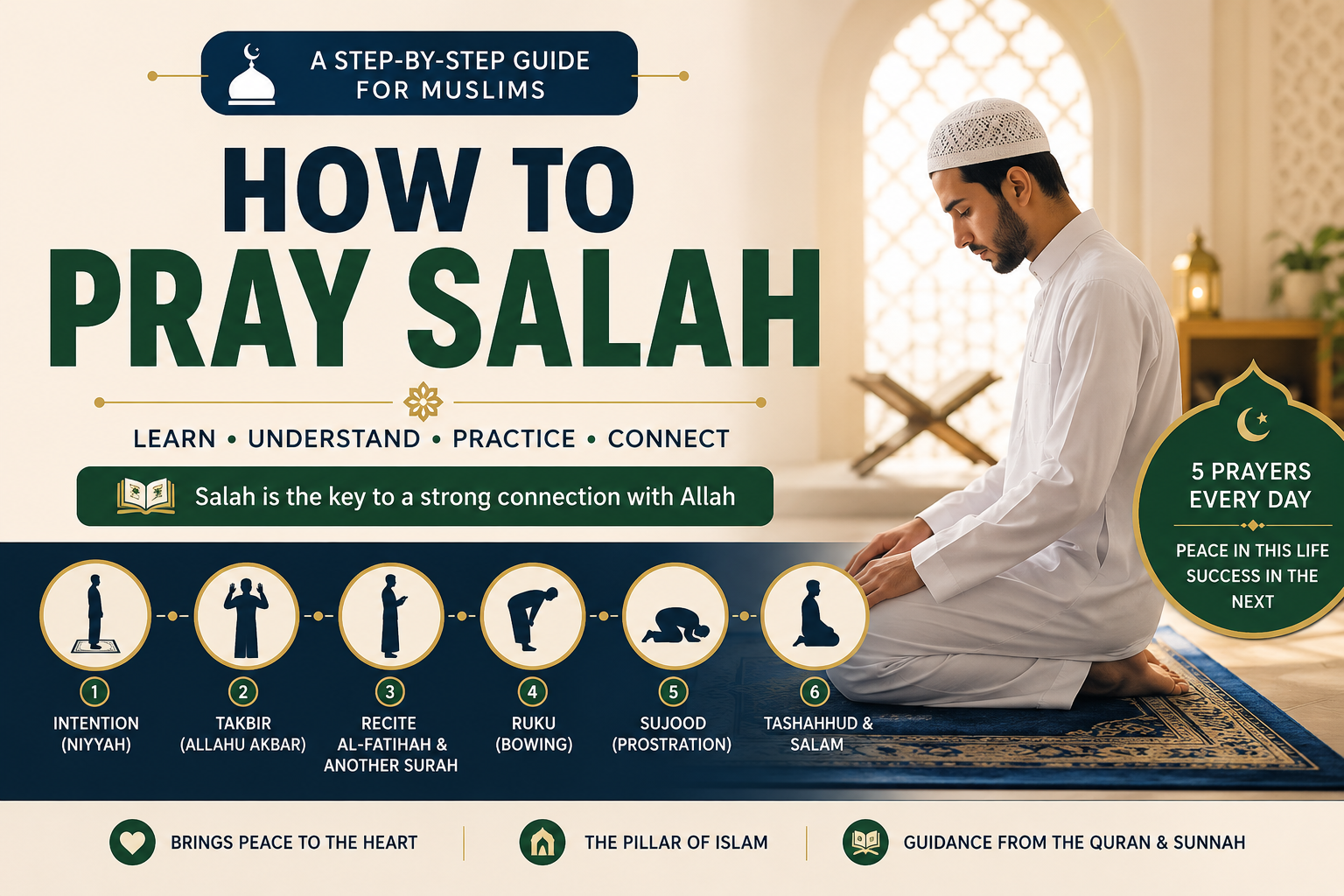
Salah is the second pillar of Islam and one of the most important acts of worship for Muslims. It is a direct connection between a believer and Allah. Every Muslim is required to perform five daily prayers at their prescribed times.
Learning how to perform Salah correctly helps ensure that your prayers are valid and accepted. Whether you are a new Muslim, a child learning prayer, or someone who wants to improve their Salah, this guide explains every step in a simple and practical way.
What Is Salah?
Salah is the obligatory worship performed by Muslims five times every day. It consists of specific physical movements, Quran recitations, supplications, and remembrance of Allah.
The five daily prayers are:
| Prayer | Obligatory Rakats |
|---|---|
| Fajr | 2 |
| Dhuhr | 4 |
| Asr | 4 |
| Maghrib | 3 |
| Isha | 4 |
Salah is not simply a ritual. It is a daily opportunity to seek guidance, forgiveness, and closeness to Allah.
Why Is Salah Important?
Salah is the foundation of a Muslim’s relationship with Allah.
The Quran repeatedly commands believers to establish prayer. It is the first deed that a person will be questioned about on the Day of Judgment.
Benefits of Salah
- Strengthens faith
- Increases discipline
- Brings peace of mind
- Encourages gratitude
- Protects against sinful behavior
- Improves time management
- Develops spiritual awareness
In practice, many Muslims find that regular Salah provides stability during difficult times and helps maintain focus throughout the day.
Requirements Before Performing Salah
Before beginning prayer, several conditions must be fulfilled.
1. Perform Wudu (Ablution)
Wudu is a ritual purification that prepares a Muslim for prayer.
You should wash:
- Hands
- Mouth
- Nose
- Face
- Arms
- Head
- Ears
- Feet
Without valid Wudu, Salah is generally not accepted.
2. Wear Clean Clothing
Clothing must be clean and free from impurities.
3. Pray in a Clean Place
The area used for prayer should be clean.
Many Muslims use a prayer mat for convenience.
4. Face the Qibla
Face the Kaaba in Makkah before starting prayer.
Today, smartphone applications and online Qibla finders make this easy.
5. Pray Within the Correct Time
Every prayer has a specific time window.
Performing Salah within its prescribed time is essential.
How to Perform Salah Step by Step
Step 1: Make the Intention (Niyyah)
Begin by making the intention in your heart.
For example:
“I intend to pray Fajr for the sake of Allah.”
The intention does not need to be spoken aloud.
Step 2: Say Takbiratul Ihram
Raise both hands beside your ears or shoulders.
Say:
Allahu Akbar
Meaning:
Allah is the Greatest.
This marks the beginning of the prayer.
Step 3: Place Your Hands
Place the right hand over the left hand on the chest.
Stand calmly and focus on the place where you will prostrate.
Step 4: Recite the Opening Supplication
You may recite:
Subhanaka Allahumma wa bihamdika wa tabarakasmuka wa ta’ala jadduka wa la ilaha ghairuk.
Meaning:
“Glory and praise belong to You O Allah. Blessed is Your name. Exalted is Your majesty. There is no deity worthy of worship except You.”
Step 5: Recite Surah Al-Fatihah
Recite Surah Al-Fatihah completely.
This Surah is required in every rakah.
Step 6: Recite Another Surah
After Al-Fatihah recite another chapter from the Quran.
Popular choices include:
- Surah Al-Ikhlas
- Surah Al-Falaq
- Surah An-Nas
- Surah Al-Kawthar
- Surah Al-Asr
Step 7: Perform Ruku (Bowing)
Say:
Allahu Akbar
Bow down while keeping your back straight.
Place your hands on your knees.
Recite three times:
Subhana Rabbiyal Azeem
Meaning:
“Glory be to my Lord the Most Great.”
Step 8: Stand Up From Ruku
Rise from bowing and say:
Sami Allahu liman hamidah
Meaning:
“Allah hears those who praise Him.”
Then say:
Rabbana wa lakal hamd
Meaning:
“Our Lord, all praise belongs to You.”
Step 9: Perform Sujood (Prostration)
Say:
Allahu Akbar
Go into prostration.
The following body parts should touch the ground:
- Forehead
- Nose
- Both hands
- Both knees
- Toes of both feet
Recite three times:
Subhana Rabbiyal A’la
Meaning:
“Glory be to my Lord the Most High.”
Step 10: Sit Between Two Sujoods
Sit briefly and say:
Rabbighfir li
Meaning:
“My Lord forgive me.”
Step 11: Perform the Second Sujood
Repeat the same prostration.
This completes one rakah.
Step 12: Stand for the Next Rakah
Stand and repeat the same sequence.
The number of rakats depends on the prayer being performed.
Step 13: Recite Tashahhud
In the final sitting recite Tashahhud.
This is an essential part of Salah.
Step 14: Recite Salat Ibrahimiyyah
Send blessings upon Prophet Muhammad ﷺ and Prophet Ibrahim عليه السلام.
Step 15: End the Prayer With Tasleem
Turn your head to the right and say:
As-Salamu Alaikum wa Rahmatullah
Then turn to the left and repeat.
The prayer is now complete.
Common Mistakes During Salah
Many Muslims unintentionally make mistakes that affect concentration and prayer quality.
Common mistakes include:
- Praying too quickly
- Not completing Ruku properly
- Not completing Sujood properly
- Looking around during prayer
- Missing prayer times
- Incorrect pronunciation
- Lack of concentration
One common mistake beginners make is focusing on memorization while forgetting proper posture. Both are important for correct Salah.
Tips to Improve Your Salah
Learn the Meaning of What You Recite
Understanding recitations improves concentration and devotion.
Pray on Time
Timely prayer helps build consistency.
Avoid Distractions
Choose a quiet environment whenever possible.
Practice Slowly
Quality is more important than speed.
Study Authentic Sources
Learn from trusted scholars and authentic Islamic references.
Spiritual Benefits of Salah
Salah offers many spiritual and personal benefits.
Strengthens Faith
Regular prayer increases trust in Allah.
Brings Inner Peace
Prayer creates moments of calm during a busy day.
Builds Discipline
Praying five times daily develops routine and responsibility.
Encourages Gratitude
Salah reminds believers to thank Allah for His blessings.
Improves Character
Prayer encourages patience, humility, honesty, and kindness.
Frequently Asked Questions
What is Salah?
Salah is the obligatory Islamic prayer performed five times daily.
How many times should Muslims pray each day?
Muslims pray five times every day.
Is Salah mandatory?
Yes. Salah is obligatory for every adult Muslim who is mentally capable.
What breaks Salah?
Talking, eating, drinking, laughing, and actions that invalidate Wudu may break Salah.
Can I pray sitting down?
If illness or physical limitations prevent standing, you may pray sitting.
Is Wudu necessary before Salah?
Yes. Wudu is normally required before prayer.
Which Surah must be recited in every rakah?
Surah Al-Fatihah.
How long does Salah take?
Most prayers take between five and ten minutes.
Can women perform Salah?
Yes. Salah is obligatory for both men and women.
What direction should I face during prayer?
You should face the Kaaba in Makkah.
What if I miss a prayer?
You should perform the missed prayer as soon as possible.
What is Ruku?
Ruku is the bowing position in Salah.
What is Sujood?
Sujood is the act of prostration before Allah.
How many rakats are in Fajr?
Two obligatory rakats.
Which prayer has four rakats?
Dhuhr and Asr each have four obligatory rakats. Isha also has four obligatory rakats.
Learning how to perform Salah correctly is one of the most important steps in a Muslim’s journey. Salah is a direct conversation between a believer and Allah. Every movement and recitation carries spiritual meaning and reward.
Focus on learning each step correctly. Practice regularly. Pray with sincerity and concentration. Over time your confidence and connection with Allah will continue to grow.
May Allah make our prayers sincere and accepted. Ameen.